Winning the Growth Case Without Trial
- Entrepreneurship
- In the News
- March 23, 2026
Winning the Growth Case Without Trial
Why Most Lawyers Are Never Taught to Lead

Leadership training for lawyers is specialized development that teaches legal professionals how to lead people, manage teams, and grow a firm — skills law school simply does not cover.
Here is a quick overview of what it includes and who it is for:
| What It Is | Who It Is For | What It Covers |
|---|---|---|
| Structured skill-building for legal leaders | Associates, partners, in-house counsel | Self-awareness, team motivation, client strategy |
| Cohort or workshop-based programs | New to mid-level partners | Emotional intelligence, conflict resolution |
| Customized firm-wide training | Practice group heads, managing partners | Strategic planning, burnout prevention, AI integration |
You spent years mastering the law. Contracts. Litigation. Compliance. But nobody handed you a manual on how to lead a team, retain talent, or grow a practice.
That gap is not your fault.
Most lawyers were never formally taught leadership or management skills. Law school focuses on torts and procedure — not emotional intelligence or strategic planning. Yet at some point, strong technical performance leads to a leadership role. And the skills that got you here will not automatically get you there.
The result? Talented lawyers find themselves managing people, running practices, and making firm-wide decisions — without the tools to do it well. Frustration, high turnover, and stalled growth follow.
This is a real pattern playing out in firms from Philadelphia to Wilkes-Barre and well beyond.
I’m Nicole Farber, CEO of ENX2 Legal Marketing, with over 15 years of experience helping law firms grow — including speaking on self-leadership and change at leadership conferences. My work sits at the intersection of legal marketing and leadership training for lawyers, and I have seen how the right development unlocks firm-level growth that no marketing campaign alone can deliver.
Why leadership training for lawyers is the Secret to Firm Growth

In the competitive legal landscapes of Philadelphia and Wilkes-Barre, being a brilliant litigator is no longer the sole requirement for success. We have observed that the most profitable firms aren’t necessarily those with the smartest “technical” lawyers, but those with the best leaders.
When a firm invests in leadership training for lawyers, it shifts from a collection of individual practitioners to a unified, strategic machine. This evolution impacts three critical areas:
- Profitability and Growth: Effective leadership at all levels allows a firm to move beyond “random acts of marketing” and into intentional law firm development. Leaders who understand strategy can identify high-value niches and scale their operations without sacrificing quality.
- Talent Retention: High turnover is the “silent killer” of law firm margins. Lawyers don’t leave firms; they leave poor managers. By training partners to be empathetic, clear communicators, we create environments where associates want to stay, reducing the massive costs associated with recruiting and retraining.
- Market Leadership: Firms that prioritize leadership gain national recognition. They aren’t just reacting to the market; they are shaping it. This competitive advantage is what separates Firm A (which grows consistently) from Firm B (which stagnates despite having great legal minds).
The 4 Pillars of a Modern Legal Leadership Framework
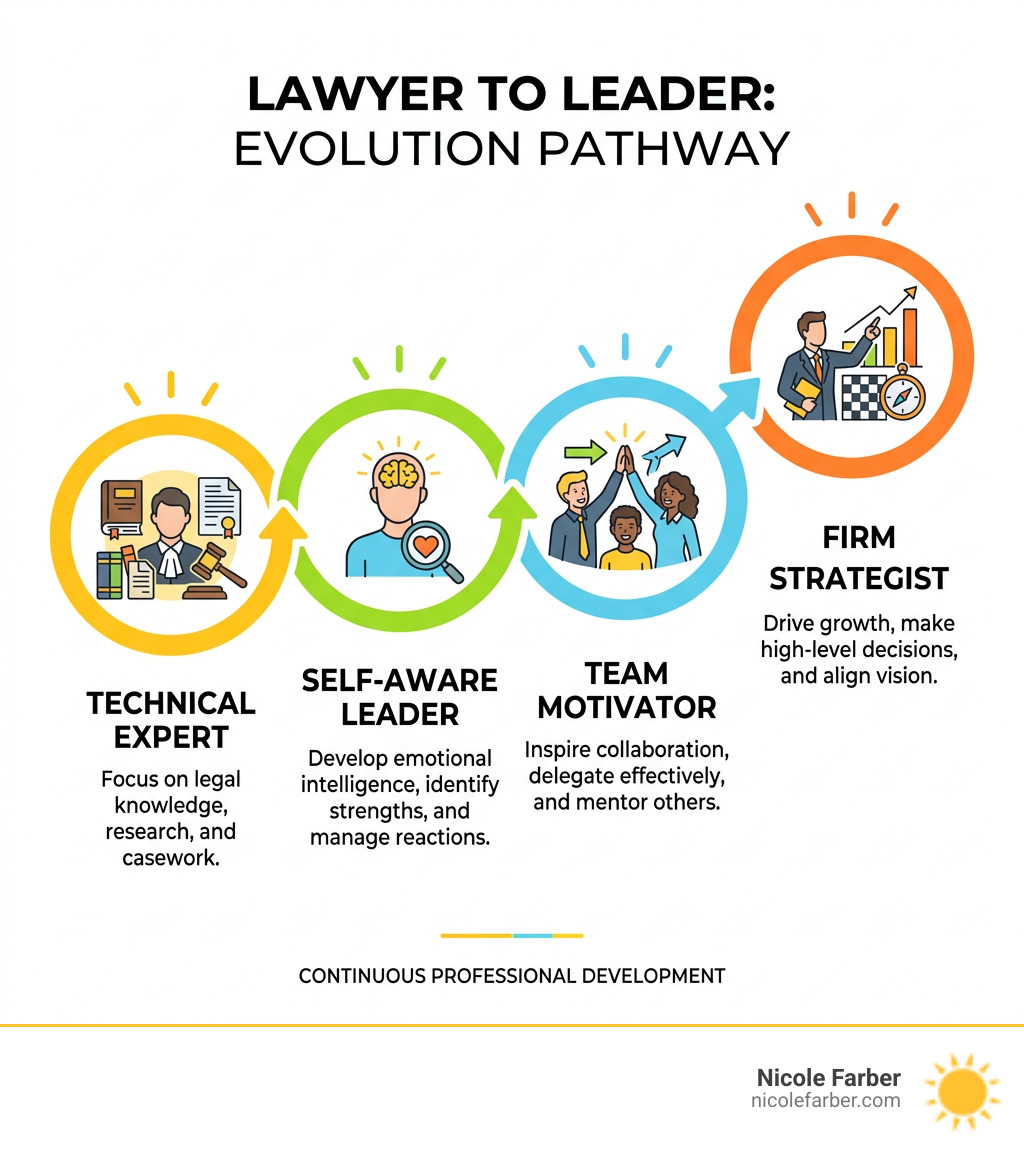
To truly transform from a technician to a visionary, we recommend a framework that covers four distinct dimensions. This holistic approach ensures that no part of the professional journey is left to chance. You can explore how this fits into your broader goals through business coaching for lawyers.
- Personal Leadership: This is the foundation. It’s about self-awareness, confidence, and understanding how your personal values and background shape your decision-making. Before you can lead a room in New Orleans or a courtroom in Luzerne County, you must be able to lead yourself.
- Team Leadership: This involves the “people skills” often ignored in law school. It includes motivating high-performers, delegating effectively without micromanaging, and fostering a culture of psychological safety.
- Practice/Firm Leadership: Here, the focus shifts to the business. It involves strategic planning, analyzing business unit performance, and driving internal collaboration. It’s about moving from “my cases” to “our firm’s success.”
- Client Leadership: Modern clients want more than a vendor; they want a partner. This pillar teaches lawyers how to communicate value, manage pricing conversations, and deepen relationships through high-level collaboration.
Implementing leadership training for lawyers in Your Firm
Implementation shouldn’t be a one-size-fits-all “check the box” activity. Whether your firm is based in New Orleans or Philadelphia, the most effective programs are those that are 100% customized to your specific culture and challenges.
We see the best results when firms use cohort-based learning. This allows peers to learn from one another, sharing real-world challenges in a confidential setting. Mentorship also plays a vital role—pairing emerging leaders with seasoned partners to bridge the gap between theory and practice. Peer-to-peer discussions are often where the “aha” moments happen, as lawyers realize their struggles with delegation or burnout are shared by their colleagues.
The ROI of leadership training for lawyers
Investing in people is not a “soft” expense; it is a strategic investment with a measurable Return on Investment (ROI). Firms that implement structured leadership training for lawyers typically see:
- Increased Engagement: Teams that feel led, rather than just managed, are more productive and committed.
- Lower Turnover: Retaining just one senior associate can save a firm hundreds of thousands of dollars in lost productivity and search fees.
- Higher Billables: When leaders manage their time and teams effectively, the entire firm becomes more efficient, often leading to better realization rates and higher billable output.
- Client Satisfaction: Leaders who excel at “Client Leadership” build trust that leads to more referrals and long-term loyalty.
Essential Skills Taught in High-Impact Programs
What exactly happens inside a high-impact training session? It’s not about memorizing more case law. It’s about developing “soft skills” that yield hard results. Through executive coaching for lawyers, we focus on several core competencies:
- Emotional Intelligence (EQ): Learning to read the room, manage your own stress, and respond to others with empathy. This is critical for everything from jury selection to partner meetings.
- Negotiation and Influence: Moving beyond “adversarial” negotiation to find win-win solutions that preserve relationships while achieving firm goals.
- Conflict Resolution: Addressing “siloed” practices and internal friction before they turn into toxic culture.
- AI Integration: Understanding the ethical and practical implications of new technologies. A modern leader doesn’t just use AI; they lead their team through the transition.
- Ethical Leadership: Navigating the complex intersection of professional responsibility and business growth.
Overcoming Burnout and Turnover Through Strategic Development
The legal profession is notorious for burnout. Often, this is caused by a lack of leadership structure. When every partner operates as a “silo,” communication breaks down, and the workload becomes unsustainable.
Firms in Luzerne County and across the country are finding that leadership training for lawyers is the best antidote to exhaustion. By teaching performance optimization and change management, we help lawyers work smarter, not just harder.
| Technical Legal Skills | Leadership Competencies |
|---|---|
| Case Law Research | Strategic Vision & Planning |
| Document Drafting | Team Motivation & Coaching |
| Courtroom Advocacy | Emotional Intelligence |
| Statutory Interpretation | Conflict Management |
| Due Diligence | Change Management |
By focusing on these competencies, firms can move toward a more sustainable model. This is a foundational part of building a law firm that lasts for generations rather than one that burns out its best people.
Future Trends: AI Integration and Agile Leadership
The future of law is global, digital, and . Even in our beautiful location in Antigua Guatemala, legal professionals are seeing how technology bridges the gap between local practice and global standards.
- AI Academies: We are seeing a rise in specialized training that helps lawyers lead “AI-first” teams. It’s not just about the tech; it’s about the leadership required to implement it ethically.
- Agile Methodology: Borrowed from the tech world, agile leadership allows law firms to pivot quickly in response to market changes or new regulations.
- Inclusive Success: Modern leadership training emphasizes diversity and global connectivity. Leaders who can work effectively across different life experiences and geographies are the ones who will thrive in a connected world.
- Peer Learning Networks: The “lone wolf” era of law is ending. The future belongs to leaders who participate in active, peer-driven networks to solve complex problems.
Frequently Asked Questions about Legal Leadership
Why isn’t being a great technical lawyer enough for leadership?
Technical skills are about doing the work; leadership is about enabling others to do the work. The skills required to analyze a contract are entirely different from the skills required to inspire a team of associates or navigate a firm-wide merger. As the saying goes, “What got you here, won’t get you there.”
Who should participate in legal leadership programs?
While often targeted at new partners, leadership training is valuable for everyone from senior associates (preparing for the “partner track”) to managing partners and C-suite executives (CFOs, CMOs). In-house counsel also benefit greatly, as they must lead across different business departments.
How long does it take to see results from leadership training?
While some mindset shifts happen immediately, true skill mastery usually takes time. Many high-impact programs run for 10 to 12 weeks, allowing participants to apply what they learn in real-time and return to the group for feedback. You will often see “quick wins” in team communication within the first month.
Conclusion
At the end of the day, your law firm is only as strong as its leaders. My own journey—from a single mother to a CEO and motivational speaker—has taught me that leadership is a choice, not a title. It requires faith, resilience, and a commitment to continuous growth.
We believe that every lawyer has the potential to be a great leader. Whether you are in Philadelphia, New Orleans, or Antigua Guatemala, the path to a more profitable, sustainable, and joyful practice starts with investing in yourself and your team.
Are you ready to lead your firm into its next chapter? Claim your Business Leadership Coaching Guide and let’s start winning the growth case together.