Mentorship Magic: Discovering Top Business Mentoring Programs
- Entrepreneurship
- In the News
- February 9, 2026
Why Every Entrepreneur Needs a Business Mentor

Business mentorship programs connect entrepreneurs with experienced advisors who provide guidance, accountability, and strategic insights to help you launch, grow, and sustain your business. These programs range from free volunteer-based services like SCORE to formal government initiatives and specialized programs for underrepresented entrepreneurs.
Top Business Mentorship Programs to Consider:
- SCORE – Free mentorship with 10,000+ volunteer mentors nationwide
- Small Business Development Centers (SBDCs) – Nearly 1,000 centers offering free advice
- Veterans Business Outreach Centers (VBOCs) – 22 centers supporting veteran entrepreneurs
- Women’s Business Centers (WBCs) – Specialized support for women entrepreneurs
- SBA Mentor-Protégé Program – Formal program pairing small businesses with established mentors
- Local Chambers of Commerce – Community-based mentorship in cities like Philadelphia, Wilkes-Barre, and New Orleans
Starting or growing a business is overwhelming. You’re making critical decisions daily, often without a roadmap. The statistics tell a compelling story: Entrepreneurs who work with a mentor are five times more likely to start a business than those who don’t. Small business owners who receive three or more hours of mentoring report higher revenues and increased growth. In FY24 alone, SCORE supported the launch of 59,447 new small businesses.
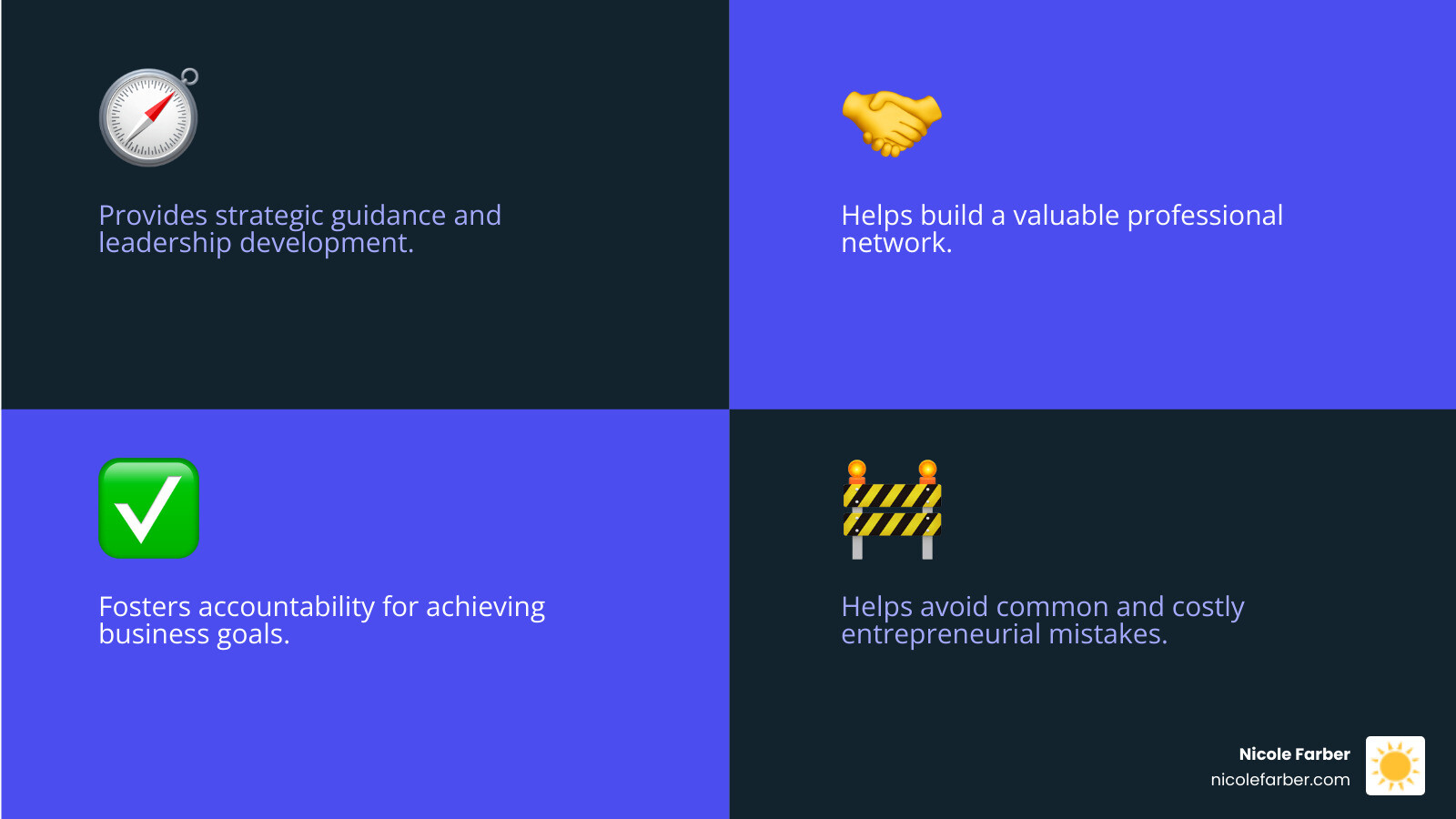
But mentorship is more than just statistics; it’s about having an experienced guide in your corner. A mentor helps you avoid common mistakes, build your professional network, and gain the accountability needed to turn uncertainty into confident action.
Whether you’re a law firm partner looking to expand your practice in Philadelphia, a startup founder navigating the early stages in Wilkes-Barre, or an entrepreneur seeking growth opportunities in New Orleans or Luzerne County, the right mentor can be your unfair advantage.
I’m Nicole Farber, and over my 15+ years as a business owner and mentor, I’ve witnessed how business mentorship programs transform entrepreneurs. My work with law firms and small businesses has shown me that the right guidance at the right time can mean the difference between closing your doors and scaling to the next level.
The Unfair Advantage: Understanding the Power of Business Mentorship
Business mentorship is a relationship where an experienced individual (the mentor) guides a less experienced person (the mentee) on their professional journey. Unlike a consultant hired for a specific project, a mentor is a long-term guide who offers ongoing support based on real-life experience. They share wisdom, help steer challenges, and provide a fresh perspective. Crucially, mentors often volunteer their time to “pay it forward,” investing in the next generation of entrepreneurs, whereas consultants charge for their services.

The benefits of engaging with business mentorship programs are profound, with statistics showing that small business owners who receive three or more hours of mentoring report higher revenues and increased growth. Here’s how a mentor provides that unfair advantage:
- Leadership and Guidance: Mentors offer seasoned insights, helping you hone leadership skills and make smarter strategic decisions. This guidance is invaluable for developing future-forward strategies, as discussed in our Business Leadership Mentor Tips 2025 guide.
- Avoiding Common Mistakes: A mentor helps you sidestep errors they’ve already made. By sharing their experiences, they provide a shortcut to wisdom, which is crucial for Overcoming Business Challenges efficiently.
- Building a Professional Network: A mentor often opens doors to their own network, introducing you to potential partners, customers, and other professionals, creating a community of support that might otherwise take years to build.
- Fostering Accountability: A good mentor helps you set realistic goals and holds you accountable for achieving them. This can be a powerful motivator to stay on track and push through obstacles.
- Emotional Support: Entrepreneurship can be lonely. Mentors provide a much-needed sounding board, offering encouragement and understanding during stressful times.
Why Mentorship is Often Free
It might seem too good to be true, but valuable mentorship often comes at no cost. The reason is simple: many experienced professionals feel a strong desire to “pay it forward.” They volunteer their time through organizations like SCORE, which has over 10,000 mentors nationwide, because they believe in small business and want to help others succeed. In FY24 alone, SCORE volunteers contributed 4 million volunteer hours.
This volunteer-driven model, which generates significant returns for the economy, means the financial barrier for mentees is minimal or nonexistent. While some programs may have small administrative fees, the core value is an exchange of experience for growth, not a paid transaction. This relationship-focused approach is a key distinction from paid consulting. For those looking to understand the broader impact of guidance, our Entrepreneurship Life Coach Ultimate Guide digs into the personal growth aspects that often intertwine with business success.
Finding Your North Star: Where to Find Quality Business Mentorship Programs
Finding the right mentor is like finding a guiding star for your entrepreneurial journey. We’ve seen countless entrepreneurs, from those starting a new venture in Luzerne County to established professionals in New Orleans, transform their businesses with the right guidance.

Here are some excellent avenues to explore:
- Personal Network: Start with who you know. Former bosses, professors, or admired business owners in your community can be potential mentors.
- Social Media: Platforms like LinkedIn are powerful tools for connecting with professionals in your industry.
- Trade Associations: Industry-specific associations often have formal or informal mentorship programs.
- Local Organizations: Your local Chamber of Commerce in Philadelphia or New Orleans is an excellent resource for networking and connections.
- Government Programs: The U.S. Small Business Administration (SBA) and its partners offer a wealth of free business mentorship programs.
- Virtual Mentorship Platforms: Technology makes it possible to connect with mentors across geographical boundaries.
Leveraging National and Local Business Mentorship Programs
The SBA’s resource partners are a cornerstone of free business support:
- SCORE: Connects you with its vast network of volunteer mentors. You can Find a SCORE office near you, such as the one serving Philadelphia, and learn How SCORE Mentoring Works.
- Small Business Development Centers (SBDCs): Nearly 1,000 centers, like the one at Wilkes University, offer free business consulting and training. Find an SBDC near you.
- Veterans Business Outreach Centers (VBOCs): Provides entrepreneurial training and counseling to service members, veterans, and military spouses. Find a VBOC near you.
- Women’s Business Centers (WBCs): Offers free-to-low-cost counseling and training for women entrepreneurs. Find a WBC near you.
Beyond these national programs, look for local incubators like the Techcelerator @ Luzerne County or community initiatives in Philadelphia, Wilkes-Barre, and New Orleans. International entrepreneurs can explore hubs like Impact Hub Antigua. For custom guidance custom to your challenges, we invite you to Find a Mentor with Nicole Farber.
Support for Underrepresented Entrepreneurs
We are passionate about empowering all entrepreneurs. Many business mentorship programs are designed to address unique challenges and foster equitable growth:
- Women’s Business Centers (WBCs) provide targeted support for women who want to start, grow, and expand their businesses. We are deeply committed to Empowering Women Entrepreneurs.
- The Minority Business Development Agency (MBDA) offers minority-owned businesses access to business experts at its centers nationwide. You can Locate an MBDA Business Center near you.
- Veterans Business Outreach Centers (VBOCs) focus on entrepreneurial development for veterans and military spouses, with programs like “Boots to Business.”
- For those seeking mentorship from diverse backgrounds, initiatives supporting Black Female Business Coaches and other specialized groups are growing, offering culturally relevant guidance.
These dedicated programs ensure that all entrepreneurs, regardless of background, have access to the resources and mentorship needed to thrive.
The Mentor-Mentee Playbook: Maximizing Your Relationship
Once you’ve found a potential mentor, the next step is to cultivate a productive and respectful relationship. This requires active engagement from the mentee.
Qualities of an Exceptional Business Mentor
What makes a good mentor stand out? We’ve identified several key traits that contribute to a truly impactful mentorship:
- Expertise and Experience: A mentor should possess relevant knowledge and a proven track record in areas where you seek guidance.
- Strong Communication: An effective mentor can articulate ideas clearly and provide constructive feedback.
- Good Listening Skills: A great mentor listens actively to understand your challenges and goals before offering advice.
- Shared Values: Having a similar work ethic or shared values, such as Faith-Based Business Leadership, can strengthen the bond.
- Lifelong Learner: An exceptional mentor is intellectually curious and committed to keeping their own skills sharp.
- Direct and Honest: A mentor should be able to deliver honest feedback, even when it’s tough, to promote your growth.
Questions to Ask Your Mentor at Every Stage
Drive the relationship by asking the right questions at the right time. Here’s a playbook:
- For Your First Meeting:
- What is the best way and frequency for us to communicate?
- What was the biggest challenge you faced when starting your business, and how did you overcome it?
- What advice do you wish someone had given you when you were at my stage?
- How can I best prepare for our next meeting to make the most of your time?
- Early-Stage Business Questions: When you’re just starting out, ask about fundamental steps like:
- What business structure is best for my business?
- Is my business plan on track, and what adjustments would you suggest?
- How can I effectively manage my initial cash flow?
- What are common pitfalls for startups in my industry?
- Growth-Stage Questions: As your business matures, the questions shift to scaling. Consider asking:
- How do I know when it’s time to hire more employees, and what’s the best approach to building a team?
- Is it time to enter new markets, and what steps should I take?
- How can I eliminate seasonal cash flow deficiencies?
- Will our current strategy take us into the future, or do we need to pivot now?
- Questions for Deeper Connection: Beyond specific business problems, a mentor can help with personal development.
- How do you maintain work-life balance amidst entrepreneurial demands?
- What strategies do you use for Strategic Goal Setting?
- What are your thoughts on my leadership style, and how can I develop it?
- How do you continue to learn and grow as a leader?
It’s our responsibility as mentees to drive the relationship, be prepared for meetings, and follow through on action items. Our guide on Building a Business Development Plan can help you structure your thoughts and questions more effectively.
A Closer Look at Top-Tier Mentorship Organizations
The landscape of business mentorship programs is diverse, with options for every entrepreneur. Programs can be structured or flexible, offering one-on-one guidance, workshops, and online resources. For instance, New Orleans has initiatives like the Freeman School of Business at Tulane University, while Luzerne County has the Techcelerator, both integrating mentorship to support local startups.
At Nicole Farber, our mentorship approach is rooted in real-life experience and faith-driven leadership. We support entrepreneurs in Philadelphia, Wilkes-Barre, New Orleans, and beyond, providing a blend of strategic advice and practical tools. Our goal is to empower business owners to build successful, sustainable ventures. We believe that effective Leadership Training in New Orleans and other locations is paramount to this success.
Virtual platforms like SCORE’s have revolutionized access to mentorship, allowing you to connect with the perfect mentor regardless of location. The duration of a mentorship can vary from a defined 12-month journey to ongoing support “for the life of your business.”
Navigating Free vs. Paid Business Mentorship Programs
The decision between free and paid programs depends on your needs, budget, and desired engagement.
Free Mentorship Models:
Many of the most impactful opportunities are free, driven by volunteers through organizations like SCORE and the SBDCs.
- Volunteer Mentors: These programs leverage the expertise of experienced professionals who offer their time without charge.
- Application Process: While free, programs often have an intake process to match mentees with suitable mentors based on industry and business stage.
- Benefits: The primary benefit is access to invaluable wisdom without the financial burden, ideal for startups.
Paid Mentorship Programs:
Paid options, like the services offered by business coaches, typically involve a more structured curriculum, guaranteed availability, and a direct client-service provider relationship, such as our Business Coaching for Lawyers.
How to Choose:
The ROI of free mentorship can be immeasurable. For foundational guidance and networking, free programs are an unparalleled resource. For highly specialized needs, a paid coach might be a better fit. We encourage you to explore your options and contact us to discuss what best fits your journey.
Understanding Mentor-Protégé Style Programs
For businesses aiming to win government contracts, the SBA’s Mentor-Protégé Program is a powerful, formal mentorship structure. It pairs small businesses (protégés) with larger, experienced firms (mentors) to foster growth.
Eligibility Criteria:
- Protégé: Must be a small business for your industry, have relevant experience, and be organized for profit. You must have a proposed mentor before applying. See Title 13 Part 125.9 of the CFR for details.
- Mentor: Must be a for-profit firm with good character, not debarred from federal contracts, and capable of providing valuable business development assistance.
Application Process:
Applicants submit a Mentor-Protégé Agreement to the SBA for approval. The SBA ensures the partnership will provide “real developmental gains” for the protégé. It’s critical that the mentor and protégé are not considered affiliated at the time of application. For details on affiliation, see Title 13 Part 121.103 of the CFR. You can manage applications at certify.sba.gov and learn more on the SBA Mentor-Protégé program page.
Frequently Asked Questions about Business Mentorship
We often hear similar questions from entrepreneurs exploring business mentorship programs. Here are some of the most common ones we address:
What is the main difference between a business mentor and a business coach?
A business mentor provides guidance based on their lived experience, often in a less formal, relationship-driven way. They act as a trusted, seasoned advisor. A business coach, however, focuses on open uping your own potential through structured processes and skill development. The relationship is typically more formal, fee-based, and geared towards specific performance goals. Our article on Business Coaching for Lawyers provides further insights.
How much time should I expect to commit to a mentorship program?
The time commitment varies, but 1-2 hours per month is a common and effective practice. Some programs suggest a 12-month journey, while others are more flexible. The key is consistency and respecting each other’s time. Always come to sessions prepared with questions to maximize the value of the time.
Can I have more than one business mentor?
Absolutely! It’s often beneficial to have multiple mentors, creating a personal “board of advisors.” You might have one mentor for marketing, like navigating an Attorney Marketing Budget, another for finance, and a third for leadership, such as a Faith-Based Life Coach. This provides a holistic view to help you make well-rounded decisions. Just be sure to manage these relationships effectively and respect each mentor’s time.
Conclusion
We’ve explored the transformative power of business mentorship programs, uncovering how these invaluable relationships serve as an unfair advantage for entrepreneurs and small business owners. From providing leadership and guidance to helping us avoid common mistakes, building robust professional networks, and fostering crucial accountability, a mentor truly is a guiding light. We’ve seen how often this profound support is offered freely, driven by a generous spirit of “paying it forward.”
Finding your North Star means knowing where to look—from your personal network and social media to national organizations like SCORE and specialized programs for underrepresented entrepreneurs. We’ve also highlighted the critical aspects of maximizing your mentor-mentee relationship, emphasizing the qualities of an exceptional mentor and the right questions to ask at every stage of your business journey.
As a motivational speaker and entrepreneur, Nicole Farber champions the transformative power of mentorship for achieving both professional and personal growth. We firmly believe that no entrepreneur should walk their path alone. The shared experience, wisdom, and encouragement offered by a mentor are not just beneficial; they are often the catalyst for turning dreams into thriving realities.
Don’t let uncertainty hold you back. Accept the magic of mentorship and Start building your successful business today.