Business Women Leadership Experts Reveal How to Lead
- Leadership
- In the News
- March 6, 2026
Business Women Leadership Experts Reveal How to Lead
Why Business Women Leadership Matters Now More Than Ever

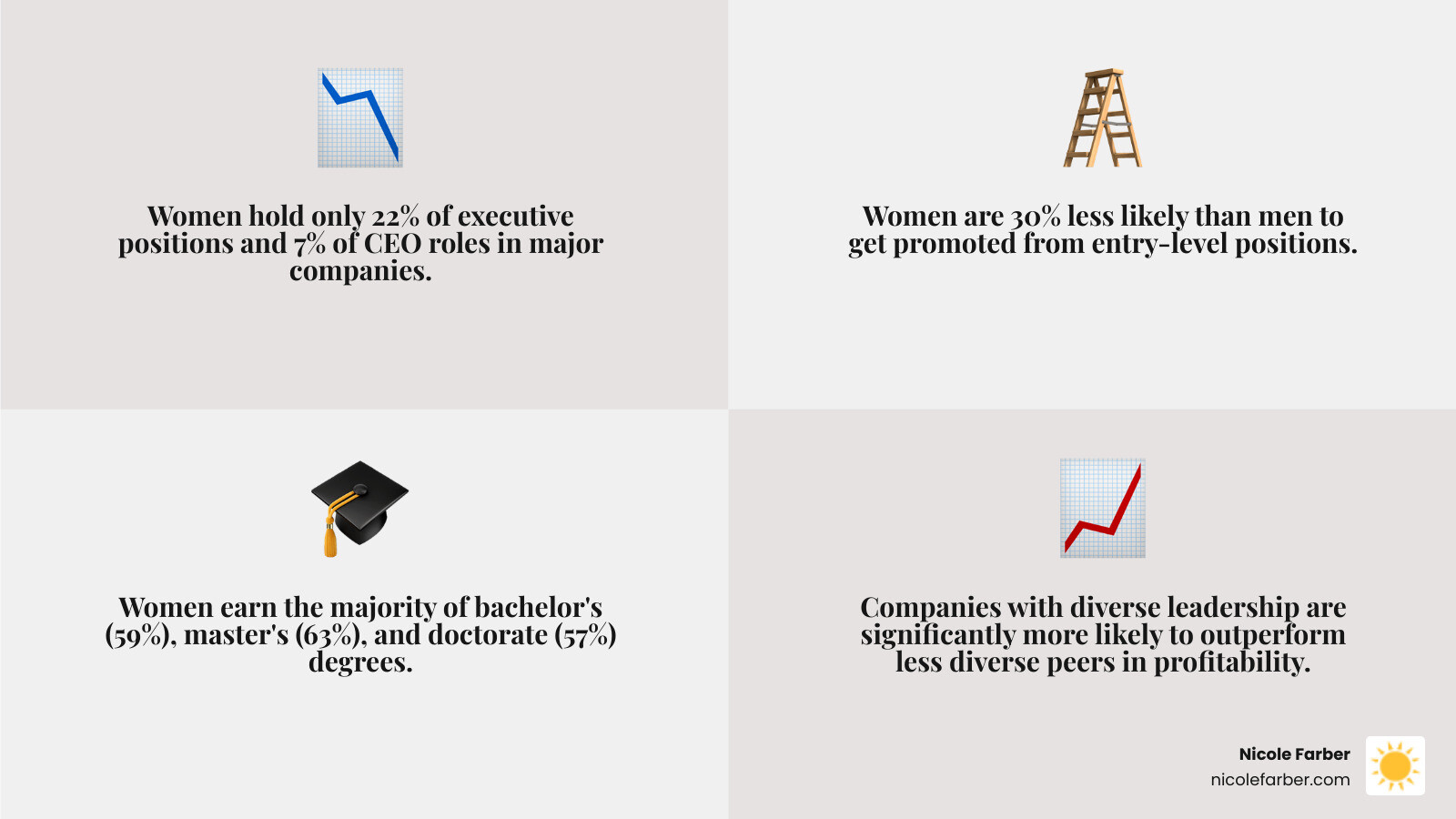
Business women leadership is at a critical crossroads. While women earn 59% of bachelor’s degrees, 63% of master’s degrees, and 57% of doctorate degrees in the United States, they hold only 22% of executive positions and just 7% of CEO roles at major companies. Here’s what you need to know:
Key Facts About Business Women Leadership:
- The Broken Rung: Women are 30% less likely than men to get promoted from entry-level positions and 60% less likely to move from middle management to executive ranks
- The Double Burden: 75.8% of part-time workers in Canada are women, with women doing almost twice as much unpaid care work as men
- The Business Case: Companies with higher gender diversity in leadership are significantly more likely to outperform their less diverse peers on profitability
- The Impact: 86% of women report that seeing more women in leadership encourages them that they can achieve it themselves
- The Gap: In Canadian corporations, women hold only 18.3% of board positions, and just 4% of the largest publicly traded companies have a woman CEO
This gap isn’t about talent or ambition. It’s about systemic barriers, unconscious bias, and outdated workplace structures that prevent capable women from reaching their full potential. From algorithmic bias in AI recruitment tools to return-to-office policies that disproportionately impact caregivers, new challenges are compounding old ones.
But there’s hope. Research shows clear strategies that work: early talent identification, strategic sponsorship (not just mentorship), and inclusive leadership cultures. Whether you’re navigating leadership in Philadelphia’s legal market, building a practice in Wilkes-Barre, or growing a business in New Orleans, understanding these dynamics is essential.
As Nicole Farber, CEO of ENX2 Legal Marketing with over 15 years of experience guiding business women leadership through both triumphs and challenges, I’ve witnessed how the right strategies transform careers and organizations. My work with law firms and businesses across the country, combined with my role as a speaker on leadership development, has shown me that when women lead with purpose and organizations commit to equity, everyone wins.
The Modern Landscape: Challenges & Opportunities for Women in Business
We often hear about the “glass ceiling,” but the reality for business women leadership is far more complex, involving both persistent systemic problems and new challenges emerging from global trends. These obstacles can feel particularly pronounced in busy business centers like Philadelphia or the vibrant, yet traditional, industries found in New Orleans. Let’s dig into the primary challenges women face today.
The “Broken Rung” and Systemic Biases
Imagine climbing a ladder, only to find the very first rung missing. This is often the experience for women in the workplace, a phenomenon known as the “broken rung.” It refers to the first critical step up to manager, where women are significantly more likely to be overlooked than men. This initial hurdle creates a ripple effect throughout their careers. We see that women are 30% less likely than men to get promoted out of an entry-level position, and a staggering 60% less likely to move from middle management into the executive ranks. This isn’t about capability; it’s about deeply ingrained unconscious bias and gender stereotypes that influence who is seen as “leader material.”

These biases perpetuate a narrow definition of leadership, often picturing a man, which influences who is chosen for leadership roles and who aspires to them. In environments from the corporate towers of Philadelphia to the close-knit communities of Luzerne County, these biases can lead to women being underestimated or their contributions being undervalued. The result? A promotion gap that makes climbing the corporate ladder feel like an uphill battle. We also know that many talented women grapple with imposter syndrome, an internal feeling of being a fraud despite external successes, which can be exacerbated when surrounded by these systemic biases. Overcoming this requires not just individual fortitude but also organizational commitment to fair and transparent promotion processes.
The “Double Burden” and Work-Life Integration
For many women, the professional ladder isn’t the only one they’re climbing. We also carry the “double burden” of professional responsibilities coupled with a disproportionate share of unpaid care work at home. Women do almost twice as much unpaid care work as men, which often encroaches on their potential for career advancement. This includes childcare responsibilities, which can lead to career interruptions that are longer and more frequent for women than for men. Such interruptions, even short-term absences for a sick child, are often stigmatized and linked to fewer promotions and salary increases.
Consider the reality for single mothers, for whom this “double burden” is often a “quadruple burden.” As a single mother and business leader myself, I’ve seen how crucial support systems and flexible structures are. Our guide, Single Mother Entrepreneurs: Complete Guide, digs into these challenges. The lack of access to affordable, quality childcare significantly influences women’s ability to participate in the workforce and pursue leadership roles, as highlighted by Oxfam Canada’s report, Who Cares? Why Canada Needs a Public Child Care System, 2019. This isn’t just a Canadian issue; it’s a global one, affecting women across the USA, including those striving for leadership in New Orleans or Wilkes-Barre. The flexibility paradox of remote work, while offering some relief, can also blur boundaries, increasing the demands on women who are juggling multiple roles.
Emerging Problems: AI Bias and Return-to-Office Mandates
Just when we thought we had identified the traditional challenges, new ones are emerging, often silently, to impact business women leadership. Two significant trends are algorithmic bias in AI-driven recruitment and the push for return-to-office (RTO) mandates.
AI tools, increasingly used in hiring and performance evaluations, are designed by humans and fed with historical data. If that historical data reflects past biases against women or certain demographics, the AI will learn and perpetuate those biases. This algorithmic bias risks entrenching existing stereotypes, making it harder for women to even get their foot in the door for leadership opportunities. It’s a subtle but insidious barrier that demands our attention.
Simultaneously, many organizations are implementing return-to-office (RTO) policies, often without a careful gender lens. These mandates can disproportionately impact women, who, as we’ve discussed, continue to bear the brunt of caregiving responsibilities. For a woman in New Orleans with limited childcare options or a professional in Luzerne County facing a long commute, a rigid RTO policy can force a difficult choice between career advancement and family needs. The McKinsey & Company report, Women in the Workplace, 2021, underscores how these policies can inadvertently push women out of the workforce or limit their leadership potential. We must advocate for policies that offer genuine flexibility and support, ensuring that our advancements in technology and workplace structure don’t inadvertently create new barriers for women.
Cultivating Success: Key Skills and Strategies for Business Women Leadership
Navigating the complex landscape of modern business requires more than just ambition; it demands a specific set of skills and a strategic approach. For business women leadership, cultivating these attributes and knowing how to apply them can be the difference between stagnating and soaring. We’ve seen this in action, from the innovative startups in Philadelphia to the established firms in New Orleans.
Defining the Successful Woman Leader: Core Attributes
What truly defines a successful woman leader? While many qualities contribute, we’ve identified core attributes that consistently empower women to thrive. These include resilience, the ability to bounce back from setbacks; empathy, understanding and sharing the feelings of others; strategic thinking, foresight and planning for long-term goals; clear communication, articulating vision and ideas effectively; and humility, a willingness to learn and acknowledge limitations.

A powerful framework that encapsulates these attributes is the Centered Leadership model, developed by McKinsey. It outlines five interconnected dimensions:
- Meaning: Finding your strengths and putting them to work in service of an inspiring purpose. This isn’t just about a job; it’s about a calling.
- Managing Energy: Knowing where your energy comes from, where it goes, and how to manage it effectively, rather than just managing time.
- Positive Framing: Adopting a constructive way to view your world, expanding horizons, and building resilience to overcome challenges.
- Connecting: Identifying who can help you grow, building stronger relationships, and increasing your sense of belonging.
- Engaging: Finding your voice, becoming self-reliant and confident by accepting opportunities and risks, and collaborating with others.
This holistic approach, deeply explored in McKinsey’s “Centered leadership: How talented women thrive” article, provides a roadmap for business women leadership to not just survive but truly thrive. We believe that by focusing on these areas, women can develop themselves into exceptional leaders. Our commitment to Developing Female Leaders stems from this very understanding.
Navigating the System: Overcoming Bias in Business Women Leadership
While organizations work to dismantle systemic biases, women leaders must also develop proactive strategies to steer and overcome these challenges. It’s about playing the game while simultaneously helping to change the rules.
One crucial skill is self-advocacy. We often see women hesitate to promote their achievements, fearing they might be perceived negatively. Yet, finding your voice and speaking up, even when it feels uncomfortable, is essential. This includes taking calculated risks—not reckless ones, but opportunities that align with your strategic growth, understanding that growth often lies just outside our comfort zones. When facing setbacks or criticism, learning to depersonalize feedback is vital. It’s about separating your identity from the outcome, allowing you to learn and adapt without internalizing the negativity. Building confidence, often nurtured through experience and self-reflection, is the foundation for all these strategies. It’s about knowing your worth and believing in your right to be in that leadership role.
As experts in empowering business women leadership, we know that sometimes, a little guidance can go a long way. A female leadership coach can be your secret weapon in this journey, helping you Unleash Your Inner CEO: Why a Female Leadership Coach is Your Secret Weapon. These strategies are about smashing the glass ceiling, not just politely tapping on it, as Fin24’s article, 5 ways women can smash the glass ceiling, aptly puts it. It’s about mastering the art of influence and impact in every setting, from a boardroom in New Orleans to a virtual meeting with clients in Wilkes-Barre.
The Power of Your Network: Mentorship, Sponsorship, and Allyship
In the journey of business women leadership, your network is more than just a list of contacts; it’s a lifeline, a launchpad, and a source of invaluable support. We often hear about mentorship, but it’s equally important to understand the distinct, and often more impactful, role of sponsorship and the critical contribution of allyship.
| Feature | Mentorship | Sponsorship |
|---|---|---|
| Role | Trusted advisor, guide, provides feedback and knowledge | Advocate, uses influence to create opportunities, speaks up for you when absent |
| Focus | Career guidance, skill development, personal growth | Career advancement, visibility, promotion, opening doors |
| Benefit | Learning, insights, support, sounding board | Access to senior roles, high-profile projects, greater influence |
| Action | Offers advice, shares experiences, teaches | Proactively champions your abilities, puts their reputation on the line |
| Impact | Helps you steer your career | Helps you accelerate your career |
While mentors offer invaluable guidance and support, research shows that sponsorship is more effective at helping advance into leadership positions than mentorship. A sponsor isn’t just a cheerleader; they’re an active proponent, speaking up for you when you’re not in the room and leveraging their capital to open doors you might not access otherwise.
And let’s not forget the crucial role of allyship. Allies, particularly those in positions of power, can actively challenge biases, advocate for inclusive policies, and champion the advancement of women. This includes male executives who, when trained on how to be allies, are far more likely to speak up about incidents of gender inequality. We must cultivate environments where allyship is not just encouraged but expected. Building robust professional networks, whether through formal programs or informal connections, is vital. This is why local initiatives like Philadelphia Women in Business are so important—they provide platforms for women to connect, learn, and grow together, fostering both mentorship and sponsorship opportunities.
The Organizational Imperative: Building a Pipeline for Female Leaders
Beyond individual strategies, organizations play a pivotal role in fostering business women leadership. Prioritizing gender diversity isn’t just a moral imperative; it’s a strategic business decision that yields tangible benefits for companies operating anywhere from the busy markets of New Orleans to the specialized industries of Luzerne County.
The Business Case for Gender Diversity
Let’s be clear: gender diversity in leadership isn’t just “nice to have”; it’s a competitive advantage. The tangible benefits for organizations that prioritize and achieve gender diversity are compelling and well-documented.
Companies with higher levels of gender, ethnic, and cultural diversity are more likely to outperform their less diverse peers on profitability. This isn’t a coincidence. Increased diversity brings a wider range of perspectives, experiences, and problem-solving approaches, leading to improved innovation and better decision-making. When diverse voices are at the table, discussions are richer, assumptions are challenged, and solutions are more robust. This directly translates to improved company performance and greater market responsiveness. The economic benefits are undeniable; a 2017 report suggests that decreasing gender inequality in the workplace could benefit Canada’s economy by as much as $150 billion by 2026. This business case, strongly supported by studies like McKinsey & Company’s “Diversity Wins: How Inclusion Matters, 2020”, makes it an organizational imperative to actively champion business women leadership.
Strategies for Nurturing Future Business Women Leadership
For organizations committed to building a robust pipeline of female leaders, proactive strategies are key. It begins with the earlier identification of leadership potential, often much earlier than traditionally considered. By spotting and nurturing talent from entry-level positions, companies can provide the “runway” women need to develop their skills, gain experience, and build confidence.
Leadership development programs custom for women can be incredibly effective, offering targeted training, coaching, and networking opportunities that address specific challenges women face. These programs are designed to equip women with the strategic focus, communication prowess, and negotiation skills needed to excel. Equitable promotion processes are also paramount. This means actively scrutinizing hiring and promotion decisions for bias, ensuring transparency, and holding senior leaders accountable for diversity metrics.
Furthermore, Diversity, Equity, and Inclusion (DEI) initiatives must be embedded into the company culture, not just treated as separate programs. This holistic approach helps to create environments where women, and all employees, feel valued and empowered. Supporting entrepreneurs, whether they’re launching a new venture in Wilkes-Barre or building a business in Antigua Guatemala, also contributes to a broader ecosystem of female leadership. Our commitment to Empowering Business Owners extends to fostering these opportunities globally, knowing that every successful woman leader strengthens the collective.
Fostering an Inclusive Culture for All Genders
The goal is not just to get more women into leadership, but to create truly inclusive leadership environments that benefit everyone. This means promoting inclusive leadership styles—those that are collaborative, respect non-traditional ways of leading, accept diversity, and actively include marginalized voices. It’s about shifting from “power over” to “power with.”
Psychological safety is a cornerstone of such a culture. When employees feel safe to speak up, share ideas, and even make mistakes without fear of retribution, innovation flourishes. We also need to recognize and reward the often-invisible work women managers do in supporting colleagues’ well-being and implementing DEI initiatives. This “glue work” is critical but frequently goes unnoticed.
Flexible work policies are another non-negotiable. With the lessons learned from remote work, organizations must implement arrangements that allow women (and men) to better integrate their professional and personal lives, particularly those with caregiving responsibilities. Retaining talent in regions like Luzerne County and Wilkes-Barre means understanding the unique needs of the local workforce and adapting policies accordingly. By fostering a culture where all genders feel supported, valued, and empowered to lead authentically, we open up the full potential of our teams and strengthen our organizations from within. We are dedicated to Empowering Women Entrepreneurs by advocating for these very principles.
Frequently Asked Questions about Business Women Leadership
What is the single biggest barrier for women in leadership today?
The “broken rung” at the first step up to manager is the biggest hurdle. Systemic biases in promotions and a lack of early-career sponsorship prevent women from gaining the initial momentum needed to reach senior leadership, a problem that compounds over a career. This initial missed promotion makes it significantly harder for women to build the experience and networks required for subsequent leadership roles, creating a persistent gap that widens with each career stage.
What’s the difference between a mentor and a sponsor?
A mentor is a trusted advisor who provides guidance, feedback, and shares their knowledge to help you grow. They offer advice, share experiences, and act as a sounding board. A sponsor, however, is an advocate in a position of power who actively uses their influence to create opportunities for your advancement, often speaking up for you in high-level conversations where you aren’t present. Sponsors champion your abilities, put their reputation on the line for you, and open doors to critical roles or projects.
What is the most tangible benefit for a company that achieves gender diversity in leadership?
The most tangible benefit is improved financial performance. Extensive research consistently shows that companies with higher levels of gender and ethnic diversity in their leadership teams are more likely to outperform their less diverse peers on profitability. This is attributed to a wider range of perspectives, better decision-making, increased innovation, and a stronger understanding of diverse customer bases, all of which contribute directly to the bottom line.
Conclusion
The journey toward true equity in business women leadership is undoubtedly filled with unique challenges, but as we’ve explored, it’s also rich with opportunities for growth, impact, and profound change. We’ve seen how systemic barriers like the “broken rung” and emerging issues like AI bias can impede progress, but we’ve also highlighted the critical skills—resilience, empathy, strategic thinking—and proactive strategies that empower women to rise.
Cultivating a powerful network through mentorship, sponsorship, and allyship is not just a career hack; it’s a fundamental pillar of support and advancement. And for organizations, the message is clear: embracing gender diversity in leadership isn’t just the right thing to do, it’s a strategic imperative that drives profitability, innovation, and overall business success.
Leadership is not just a title, but a journey of empowerment and impact. It’s about leading with purpose, resilience, and a deep understanding of what it takes to build a more inclusive and equitable future. As a Female Leadership Speaker, Nicole Farber draws on her own journey to inspire women to lead with purpose and resilience, understanding the unique landscape of challenges and opportunities.
Ready to take the next step in your leadership journey? Explore our comprehensive guide on Women in Business Leadership to open up your full potential and become the leader you were meant to be.