The Leader’s Compass: Navigating the Core Concepts of Effective Leadership
- Leadership
- Word of the Day
- January 16, 2026
Why Understanding Leadership Matters More Than Ever

What is leadership in today’s world? It’s the ability to influence and guide people toward a common goal through inspiration and empowerment. Effective leadership is a social process built on several core components:
- Influence: Inspiring others to take voluntary action.
- Shared Vision: Aligning a team around common goals.
- Empowerment: Enabling others to reach their full potential.
- Direction: Providing clarity on the path forward.
- Commitment: Fostering dedication and ownership.
The stakes for getting leadership right are high. A staggering 75% of workers find their manager to be the most stressful part of their day. But when leadership works, the results are transformative: happy workers are 13% more productive, and companies with strong leadership development see 20 times greater employee retention.
Whether you’re leading a law firm in Philadelphia, a team in Wilkes-Barre, or a business in New Orleans, these principles apply. Great leadership isn’t about having all the answers; it’s about creating an environment where others can thrive.
As Nicole Farber, CEO of ENX2 Legal Marketing, I’ve seen how understanding what is leadership transforms businesses. My work with firms across the country has shown me that authentic leadership, rooted in purpose and care, is the foundation of sustainable success.
What is leadership word guide:
- Business leadership tips
- being a good leader in the workplace
- how to become a good leader in workplace
What is Leadership at Its Core?
What is leadership at its heart? It’s the art of guiding people toward a shared goal through influence and inspiration, not just a title on a business card. It’s a social process that happens between people. Whether you’re running a law firm in Philadelphia or organizing a community event in Luzerne County, leadership emerges when you help a group move from confusion to clarity.
Anyone can practice leadership. Every time you help a colleague solve a problem or rally your team around a new idea, you’re leading.

The Three Pillars of Effective Leadership: DAC
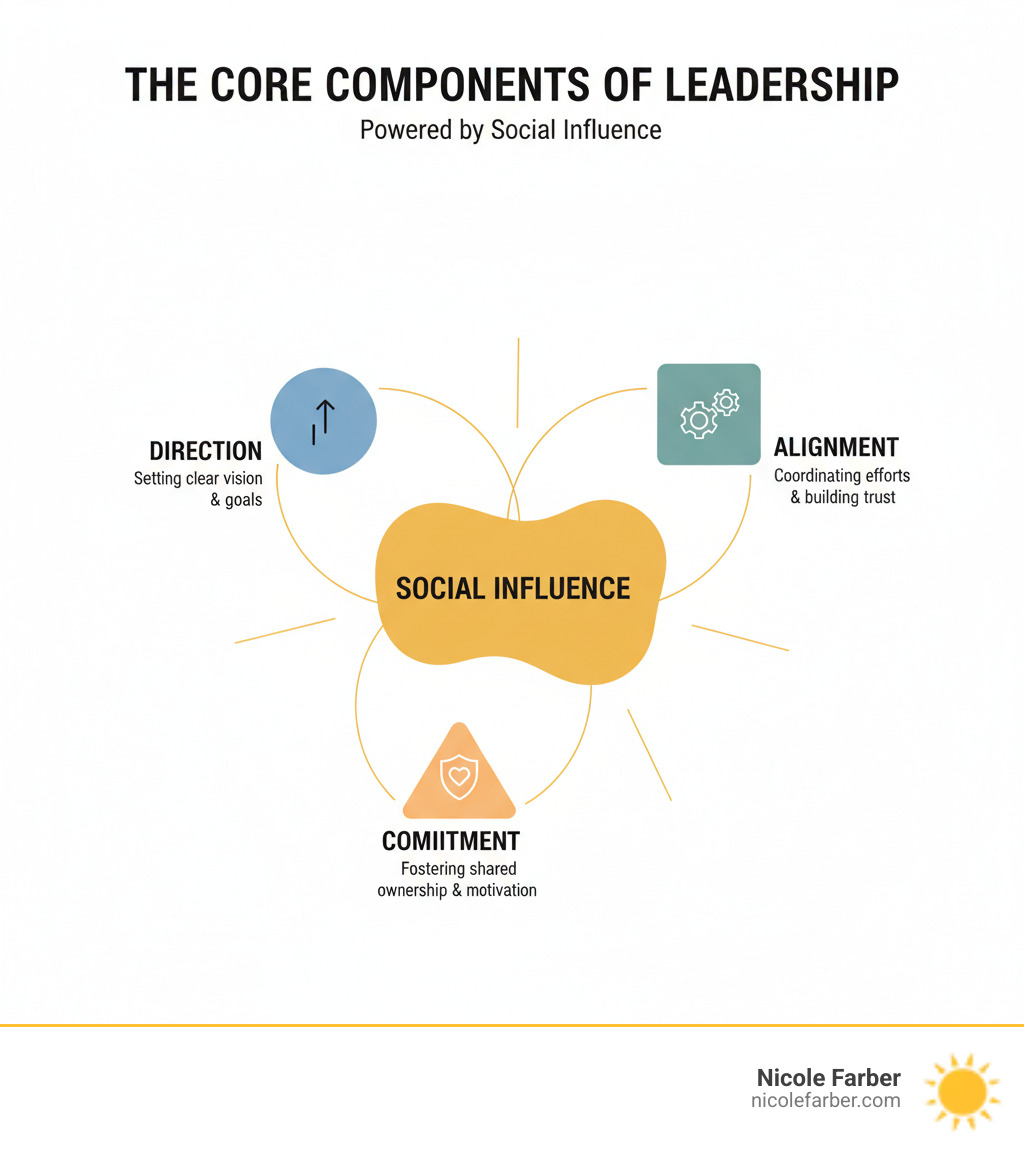
Research shows that all effective leadership produces three outcomes, known as the DAC Framework: Direction, Alignment, and Commitment.
- Direction: This is about creating a clear, shared vision. The most successful law firm leaders I work with can articulate where the firm is headed so clearly that everyone, from partners to paralegals, understands the destination.
- Alignment: This is about coordinating efforts to ensure everyone is working in harmony. It means the marketing team in your Wilkes-Barre office and the client service team are in sync, and everyone understands their role.
- Commitment: This is earned, not demanded. It’s when team members feel genuine ownership of the group’s success and are invested in the outcome. You’ll see it when people say “we” instead of “they” when discussing company goals.
When these three elements are strong, real leadership is happening.
Assigned vs. Emergent Leadership
Leadership comes in two forms. Assigned leadership is formal, given to someone through a promotion or title. They have official authority.
Emergent leadership is informal and often more powerful. It happens when someone becomes influential because others naturally turn to them for guidance, like a trusted paralegal in a New Orleans office or a community organizer in Antigua Guatemala. These leaders have personal power, earned through trust and expertise, which inspires people to follow them. The most effective leaders blend this with their position power, understanding that true influence comes from earning respect, not just demanding it.
The Evolution of Leadership: From Command to Collaboration
Understanding what is leadership has evolved dramatically. Early theories like the Great Man Theory suggested leaders were born, not made. This shifted to the Trait Theory, which sought a universal recipe of leadership characteristics. The real breakthrough came with Behavioral and Situational Theories, which moved the focus from who leaders are to what they do and how they adapt their style to the situation. Today, we know leadership is a complex, relational process far from the old command-and-control models.
The Modern Leader’s Mandate
The 21st-century leader is a collaborative enabler, not a top-down commander. Their mandate is to create environments where people thrive. Key priorities include:
- Fostering Inclusivity: Creating spaces where diverse perspectives are valued is critical for innovation, whether in a Luzerne County startup or a global team in Antigua Guatemala.
- Empowering Employees: Trusting people with autonomy leads to better, faster decisions. Empowered employees are over three times more likely to report their organization makes high-quality choices.
- Creating Psychological Safety: When teams feel safe to share ideas, take risks, and admit mistakes, creativity and communication flourish.
- Prioritizing Employee Well-being: With 75% of workers stressed by their managers, focusing on well-being is both a moral and a competitive advantage. Happy workers are 13% more productive.
These priorities are the foundation of an effective Good Leader Workplace Guide.
Technology and the Changing Work Environment
Technology has revolutionized leadership. The digital landscape offers new opportunities and challenges for leaders of teams in Philadelphia, Luzerne County, and beyond.
- Virtual Communication: Tools like video conferencing and project management platforms are now essential for connecting with hybrid and remote teams.
- Data-Driven Decisions: Leaders can now use real-time analytics to move beyond gut instinct and make evidence-based strategic choices.
- Real-Time Feedback: Continuous feedback loops have replaced annual reviews, creating more agile and responsive organizations.
Mastering digital tools is crucial for leading effectively in today’s work environment, ensuring every team member feels connected and valued, no matter their location.
Leadership vs. Management: Clarifying the Distinction
Many people use the terms leadership and management interchangeably, but they are fundamentally different. Understanding this distinction is crucial for any organization, from a law firm in Philadelphia to a startup in New Orleans. As authority John Kotter said, “Management is about coping with complexity. Leadership, by contrast, is about coping with change.”
In short, managers “do things right,” while leaders “do the right thing.”
| Feature | Leadership | Management |
|---|---|---|
| Primary Focus | Vision, Inspiration, Change, People | Tasks, Processes, Stability, Execution |
| Approach | Proactive, Transformative, Strategic | Reactive, Transactional, Tactical |
| Time Horizon | Long-term (future-oriented) | Short-to-medium term (present-oriented) |
| Role | Sets direction, Aligns people, Motivates | Plans, Organizes, Controls, Staffs |
| Key Question | “What should we be doing?” | “How can we do what we’re doing better?” |
| Influence | Through inspiration, trust, shared values | Through authority, rules, procedures |
| Outcome | Growth, Innovation, Engagement | Order, Efficiency, Consistency |
Leaders inspire by painting a compelling picture of the future. Managers organize by creating systems and tracking progress to ensure things run smoothly.
An organization needs both. I’ve seen many businesses in Luzerne County and Wilkes-Barre that are over-managed and under-led. They run efficiently but lack inspiration and direction. Conversely, great vision without solid management leads to chaos. The most effective people learn to wear both hats, setting the vision and creating the systems to achieve it.
For more insights into balancing these crucial roles, explore Nicole Farber’s Business Leadership Complete Guide.
The Spectrum of Leadership Styles and Their Impact
There is no single best leadership style. What is leadership in practice often means adapting your approach to the situation and your team’s needs. The most effective leaders, from Wilkes-Barre to Antigua Guatemala, are flexible and know when to shift their style.

Command-and-Control Styles: Autocratic & Transactional
These top-down approaches are useful when speed and clarity are essential.
- Autocratic Leadership: The leader makes decisions with little team input. This is effective in a crisis or on a tight deadline, like a Luzerne County law firm preparing for court. Pros: Quick decisions, clear direction. Cons: Can stifle creativity and lower morale if overused.
- Transactional Leadership: This style uses a system of rewards and consequences. It provides clear structure and works well for routine tasks. Pros: Clear expectations, consistent performance. Cons: Can lead to a focus on rewards over genuine engagement.
People-First Styles: Changeal, Servant & Democratic
These styles prioritize people and build strong, engaged teams.
- Changeal Leadership: Leaders inspire teams to exceed their own expectations and develop into leaders themselves. This fosters high engagement and innovation, as I’ve seen in Philadelphia law firms that focus on inspiring change.
- Servant Leadership: The leader prioritizes the team’s growth, well-being, and autonomy, flipping the traditional power structure. This builds incredible trust and loyalty.
- Democratic Leadership: The leader involves the team in decision-making. This leads to higher job satisfaction and creativity but can be slower and more complex to manage.
Focusing on people-first leadership is smart business. As research shows, happy workers are 13% more productive. The best leaders move fluidly between styles, adapting to what the moment requires.
Cultivating Your Inner Leader: A Practical Guide
Leadership is not a mystical quality; it’s a skill set developed through a journey of continuous growth. It starts with self-reflection and a willingness to step outside your comfort zone to learn and unlearn habits.

Key Characteristics of an Effective Leader
Effective leaders develop specific skills and behaviors. According to McKinsey, four key behaviors account for 89 percent of leadership effectiveness: being supportive, focusing on results, seeking different perspectives, and solving problems effectively. Other crucial characteristics include:
- Communication: The ability to listen actively and articulate a clear vision, whether in a Philadelphia boardroom or a one-on-one in New Orleans.
- Emotional Intelligence (EQ): Understanding and managing your own emotions and recognizing them in others to build strong relationships.
- Integrity: Building trust by ensuring your actions consistently match your words.
- Resilience: The ability to bounce back from setbacks and lead with composure under pressure.
- Vision: Seeing and articulating possibilities that ignite passion and commitment.
Actionable Steps for Your Leadership Development
Ready to grow? Here are practical steps for leaders from Wilkes-Barre to Antigua Guatemala:
- Seek Feedback: Regularly ask colleagues and team members for honest input on your performance.
- Find a Mentor: Learn from someone whose leadership style you admire.
- Practice Active Listening: Focus on understanding others rather than just waiting to speak.
- Take on New Challenges: Volunteer for difficult projects or community roles in places like Luzerne County to practice your skills.
- Commit to Continuous Learning: Stay curious by reading, attending seminars, and listening to podcasts.
For deeper insights, explore How to Become an Effective Leader by Nicole Farber.
How Organizations Can Foster Leadership
Smart organizations cultivate leaders at all levels. They create a culture of leadership through empowerment, delegation, and formal mentorship programs. The results are compelling: companies with strong leadership development have 20 times greater employee retention and are far more agile in responding to change. By investing in equitable leadership development, organizations gain a significant competitive advantage.
We offer comprehensive Leadership Development Seminars to help organizations build robust leadership pipelines.
Frequently Asked Questions about Leadership
Are leaders born or made?
The answer to this age-old question is both. While some research suggests up to 30% of leadership potential may be genetic, the vast majority of what makes a leader effective are skills that can be learned and developed. The success of leaders from Philadelphia to Luzerne County comes from practice, learning from mistakes, and consciously honing skills like communication and strategic thinking. Anyone willing to put in the effort can become an effective leader.
Can you be a leader without a formal title?
Absolutely. Leadership is about influence, not a title. Some of the most powerful leaders have no formal authority. These emergent leaders earn influence through their expertise, reliability, and care for others. The team member in Wilkes-Barre who coordinates projects or the volunteer in New Orleans who rallies neighbors are both practicing leadership. If people naturally turn to you for advice, you are already leading.
What is the most important leadership skill for the future?
While many skills are important, the combination of adaptability and emotional intelligence (EQ) is crucial for future leaders. The business world is constantly changing, and leaders must be able to pivot and guide their teams through uncertainty. EQ is the key to making that adaptation successful, as it allows leaders to connect with their teams, build psychological safety, and manage the human side of change. Leaders in Antigua Guatemala and Philadelphia alike will need these skills to steer future complexities.
Conclusion: Your Leadership Journey Starts Now
Understanding what is leadership is the first step on a transformative journey. We’ve seen that leadership is a social process of influence focused on direction, alignment, and commitment. It’s a skill anyone can develop, not a title reserved for a few. We’ve also found that modern, people-first leadership is about empowerment, not domination.
Think of leadership as your compass. Whether you’re guiding a law firm in Philadelphia, building a team in Wilkes-Barre, or creating change in New Orleans, the principles of authentic, purpose-driven influence are the same. Your journey starts with self-awareness and grows through continuous learning and action.
As a single mother and business leader, I’ve learned that powerful leadership comes from real-life experience and faith-driven purpose. The challenges you face today are preparing you to be the leader you’re meant to become, whether you’re in Luzerne County or Antigua Guatemala.
The statistics are clear: good leadership drives productivity, retention, and agility. But behind the numbers are human stories of growth and connection. Your leadership journey starts now, and the world needs what you have to offer.
Ready to take the next step? Explore more leadership strategies and insights to open up your full potential.