How to make your firm more profitable than a lawyer in a room full of problems
- Entrepreneurship
- Word of the Day
- May 8, 2026
How to make your firm more profitable than a lawyer in a room full of problems
Mastering the Metrics: Essential law firm profitability tips for 2026

Law firm profitability tips are what separate firms that thrive from firms that merely survive — and in 2026, that gap is wider than ever.
Here are the most impactful ways to boost your law firm’s profitability:
- Track the right metrics — monitor utilization rate, realization rate, and collection rate weekly
- Bill more consistently — the average lawyer bills only 2.9 hours in an 8-hour workday; close that gap
- Speed up collections — firms that accept online payments get paid up to 39% faster
- Cut the right costs — discretionary expenses are only 20-30% of total costs; focus cuts there first
- Grow revenue deliberately — a 10% revenue increase with flat costs sends 100% of that gain to partners
- Automate non-billable work — AI tools can redirect 10-15 hours per week back to billable tasks
- Retain more clients — keeping a client costs far less than finding a new one
Think your firm is doing fine because revenue looks strong? Consider this: the average law firm collects only $910 for every $1,000 of billed work. That’s not a billing problem — that’s a profitability problem hiding in plain sight.
Many firms — from solo practices in Wilkes-Barre to multi-partner operations in Philadelphia — are busier than ever but less profitable than they were just a few years ago. Rising overhead, delayed collections, longer case timelines, and pressure to invest in new technology are all squeezing margins at once.
The difference between a firm that grows and one that just grinds usually comes down to one thing: knowing which levers to pull — and when.
I’m Nicole Farber, CEO in the legal marketing industry, and with years of experience turning around law firms across the country, I’ve built my career around law firm profitability tips that actually move the needle — not just theory, but strategy that works in the real world. Let’s get into it.
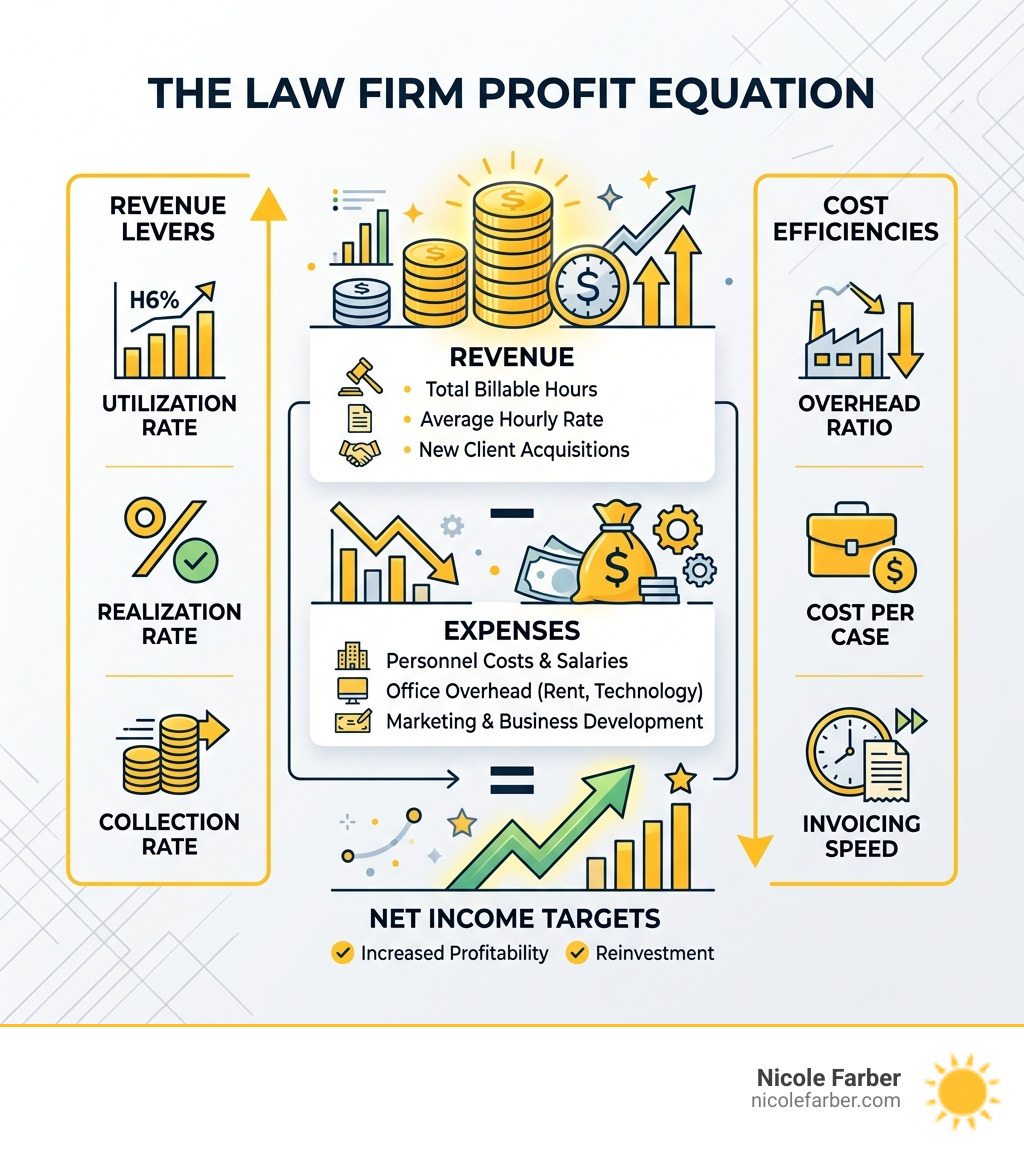

To run a profitable firm in 2026, we have to stop thinking only as practitioners and start thinking as operators. Many of us in the legal world get caught up in the “vanity metrics” — how many clicks our website got or the total gross revenue we brought in last month. But revenue is a vanity metric; profit is sanity.
A crucial distinction we must make is between revenue and profitability. Revenue is the total amount of money coming through the door. Profitability is what actually stays in the bank after every salary is paid, every lease in Philadelphia is settled, and every software subscription is cleared.
The general rule of thumb for a healthy law firm is a net income margin of 30% to 50%. If your margin is higher than 60%, you might actually be under-investing in your firm’s future growth or staff training. If it’s lower than 30%, your overhead is likely eating your lunch. To keep a firm sustainable, we recommend keeping two to six months’ worth of operating expenses on hand at all times. This creates a safety net that allows us to lead with faith and confidence rather than fear.
To truly understand your firm’s health, you need to look at Law Firm Profitability: Key Metrics and Strategies for Growth. This includes tracking your “GAAP Light” financials — standardized statements that allow you to benchmark your performance against other firms in the United States.
We also need to be intentional about our Attorney Marketing Budget. It’s not just about spending money; it’s about knowing your Client Acquisition Cost (CAC). Ideally, your CAC should be between 20% and 30% of your average client value. If you’re spending $3,000 to get a client worth $5,000, your profitability is already on life support before the first billable hour is even logged.
Optimizing Utilization and Realization Rates for law firm profitability tips
The most overlooked “profit killer” in the legal industry isn’t high rent or expensive coffee — it’s the gap between the hours we work and the fees we actually collect. Research shows that lawyers bill an average of only 2.9 hours in an 8-hour workday. That’s a utilization rate of roughly 36%.
Where does the rest of the time go? It’s swallowed by administrative tasks, disorganized intake, and “quick questions” that never make it onto a time sheet. If we can increase our billable hours by just two per week for a team of ten professionals, at a $250 rate, we could increase net revenue by over $234,000 annually.
Then comes the “realization gap.” This happens when we work 10 hours, but only bill the client for 8 because we feel bad about how long a task took, or the partner “clips” the bill before it goes out. On average, 14% of the hours lawyers work never get paid. We call this fee leakage.
In our guide Winning the Growth Case Without Trial, we discuss how to tighten these processes. By implementing contemporaneous time tracking — recording time as you go rather than trying to remember it on Friday afternoon — you can recover 10% to 15% of revenue that is usually lost to “unnecessary adjustments.”
Implementing law firm profitability tips through AI and automation
The legal landscape in 2026 is being redefined by AI. This isn’t just about robots writing briefs; it’s about the ROI of efficiency. Firms using cloud-based legal practice management (LPM) software are 11% more likely to have strong revenue streams compared to those still tethered to old-school servers.
AI agents and automation tools can redirect 10 to 15 hours per week from non-billable administrative work back into revenue-generating activities. Imagine what your firm in Luzerne County could do with an extra 600 billable hours a year per attorney.
Automation can handle:
- Client Intake: Using CRMs to respond to leads instantly. 30% to 50% of sales go to the firm that responds first.
- Document Assembly: Turning hours of drafting into minutes of reviewing.
- Billing Reminders: Automatically nudging clients whose invoices are overdue.
For a deeper dive into how this impacts your bottom line, check out The Lawyer’s Guide to AI and ROI. The goal isn’t to replace the lawyer; it’s to replace the “busy work” that keeps the lawyer from being profitable.
Strategic Cost-Cutting and Operational Efficiency
When cash flow gets tight, many firms panic and start cutting costs indiscriminately. But here is one of our most important law firm profitability tips: you cannot cost-cut your way to greatness if you destroy your capacity to produce.
In a typical law firm, discretionary expenses (the “fun” stuff or the stuff we can easily cancel) only make up about 20% to 30% of total costs. The rest is fixed or production-related, like payroll and rent. Instead of just cutting, we need to focus on “right-sizing” and “firing ourselves” from jobs we shouldn’t be doing.
If a partner is spending five hours a week on bookkeeping or three hours a week managing the firm’s social media, they are effectively “hiring” a very expensive bookkeeper. By outsourcing these non-core functions to specialized vendors, we free up that partner to focus on high-value legal work or business development.
| Cost Category | Strategy | Profit Impact |
|---|---|---|
| Fixed Costs (Rent/Lease) | Negotiate for smaller, high-tech spaces or virtual options. | High (Long-term) |
| Variable Costs (Supplies/Travel) | Review monthly; eliminate unused subscriptions. | Moderate (Immediate) |
| Production Costs (Staffing) | Use paralegals and freelancers for lower-complexity tasks. | Very High |
| Technology | Consolidate tools into one cloud-based platform. | High (Efficiency gain) |
Building a profitable firm requires a solid foundation. If you are in the early stages or looking to restructure, our resource on Building a Law Firm provides a blueprint for creating a scalable business model that doesn’t rely solely on the owner’s billable hours.
Improving Collection Rates and Cash Flow
Cash is king, especially for firms in Wilkes-Barre or Philadelphia where the cost of doing business continues to rise. A firm can be “profitable” on paper but still go bankrupt because the money is sitting in Accounts Receivable (AR) instead of the bank account.
To fix this, we need to shorten the collection cycle. If your average “days in AR” is 60 days, try to get it down to 30. How? By making it incredibly easy for clients to pay. 79% of clients today expect the same payment options they get from major companies — meaning credit cards and online portals.
Firms that use modern payment processors get paid 39% faster. Furthermore, 60% of firms that accept credit cards get paid the same day they send the invoice. We also recommend a strict retainer replenishment policy: require clients to top up their retainer when it hits 25% of the original amount. This ensures you aren’t “financing” your clients’ litigation with your own firm’s capital.
According to Law Firm Profitability Tips: 11 Ways to Boost Revenue, capturing client feedback is another secret weapon for cash flow. Happy clients who feel cared for are far more likely to pay their bills on time and refer others to your firm.
Revenue Growth Tactics and Client Acquisition
While cost-cutting is important, revenue growth is a much more powerful lever for profitability. A 10% increase in revenue, while keeping overhead flat, doesn’t just increase profit by 10% — it often sends nearly 100% of that new revenue straight to the partners’ bottom line.
One of the most effective ways to grow revenue is through niche specialization. Data shows that specialists can command profit margins 30% to 50% higher than general practitioners. When you are “the” expert for a specific problem in Philadelphia, you don’t have to compete on price; you compete on value.
Referrals also remain the “gold standard” of client acquisition, delivering a 3x to 5x better ROI than paid advertising. However, we must ensure our referral practices are ethical. Always consult the Ethics Opinion 2004-3 – Philadelphia Bar Association to stay compliant while building your network.
For those looking to fill their pipeline with high-value cases, our guide on Client Acquisition for Lawyers explores how to use digital marketing and community leadership to attract the right kind of work.
Diversifying Revenue with Alternative Fee Arrangements
The billable hour isn’t dead, but it has plenty of company in 2026. Many profitable firms are moving toward Alternative Fee Arrangements (AFAs) like flat fees, subscription models, or value-based pricing.
AFAs align the firm’s interests with the client’s. In a billable hour model, the firm is “rewarded” for being slow. In a flat fee model, the firm is rewarded for being efficient. By using automation and standardized workflows, a firm can complete a “flat fee” project in half the time it used to take, effectively doubling their hourly rate.
This shift requires a strong grasp of Attorney Business Development. You need to know exactly how much a case costs you to produce before you can price it as a flat fee. If you don’t track your time on flat-fee cases, you’re just guessing at your profitability.
Frequently Asked Questions about law firm profitability tips
What are the most common profitability pitfalls? The top three are:
- The Cash Flow Trap: Being profitable on paper but having no cash because of high AR.
- Under-pricing: Failing to raise rates annually to keep up with inflation and rising associate salaries.
- Over-hiring: Adding permanent staff for temporary spikes in workload instead of using freelancers or outsourcing.
How often should I review my firm’s financial reports? Weekly. You should track your “vital signs” — utilization, realization, and collection rates — every single week. Monthly reviews are for deep dives into the P&L, but weekly tracking allows you to catch a problem before it becomes a crisis.
Does increasing billable hours always lead to more profit? Not necessarily. If your realization rate is low, you’re just working harder for free. Focus on improving your realization and collection rates first; it’s much easier to collect the money you’ve already earned than it is to find new hours in the day.
What is the difference between law firm revenue and profitability?
Gross revenue is the total dollar amount of all checks received from clients. Profitability (or net profit) is what remains after you subtract every single expense, including taxes, rent, and payroll. You can have a $10 million firm that is less profitable than a $2 million firm if the $10 million firm has $9.5 million in expenses.
What is a healthy net income percentage for a law firm?
As mentioned, the 30% to 50% range is the “sweet spot.” If you’re below 30%, you likely have an overhead or efficiency problem. If you’re consistently above 50%, you should look into reinvesting in better technology, staff training, or marketing to ensure sustainable growth.
How can I reduce overhead without hurting my firm’s production?
Focus on discretionary spending first — things like travel, expensive meals, or unused software. Then, look at your staffing ratios. Could a paralegal or legal assistant handle more of the administrative burden? Finally, leverage technology. An investment in a good CRM or AI tool might cost $500 a month but save you $5,000 a month in lost billable time.
Conclusion: Building a Sustainable Legacy
Improving your firm’s profitability isn’t just about the numbers on a spreadsheet; it’s about the freedom those numbers provide. Profitability allows you to reinvest in your team, provide better service to your clients, and ultimately build a legacy that lasts.
Whether you are practicing in Wilkes-Barre, New Orleans, or Philadelphia, the principles remain the same: lead with vision, manage with data, and never stop looking for ways to be more efficient. As a single mother who built a business from the ground up, I know that the journey isn’t always easy, but with faith-driven leadership and the right strategies, it is incredibly rewarding.
If you’re ready to take the next step in your firm’s journey, we invite you to explore our resources on Law Firm Development. Let’s stop just “lawyering” and start leading. Your firm’s future — and your own peace of mind — depends on it.